Cafe Hai: Where the Quest for a Great Museum Cafe Ends

Cafe Hai

My biggest complaint about museums is the crappy to mediocre cafes.  You just had a hopefully profound art experience, and you want to either a) talk about it with your friend over some good coffee, b) write about it in your journal over some good coffee, or c) space out and process what you just saw over some good coffee.  Whatever option you choose, good coffee must be involved.  Or even better, there should be some other drink that makes you abandon the coffee.  But that’s not all.

You also want that cafe to continue the art experience, with cool or warm, whimsical or elegant decor.  A thoughtful menu helps.  Relaxing natural lighting shouldn’t be optional.  Nothing should be served in a plastic or paper cup.  The drinks shouldn’t be made from instant powder.  The food shouldn’t have been frozen 5 minutes ago and unfrozen 2 minutes ago in a microwave.

Am I asking too much?

Cafe Hai

I finally found a great museum cafe. Cafe Hai is the cafe of the Museum of Contemporary Art Tokyo (I’ve got a dozen museums and exhibits I’ve been wanting to write about but I keep writing about this one!)  The restaurant serves Vietnamese food in plates, bowls and cups that are used in food stalls in Vietnam.  There’s a wall menu with items priced in dong, the Vietnamese currency.  All in the simple aesthetic of the slow food movement.  In short, a lot of thought went into this space.

Cafe HaiCafe Hai

Cafe Hai

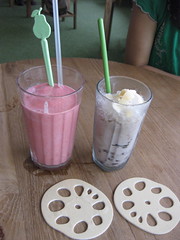
The drink menu was so intriguing that we ordered the delicious frothy concoctions.  Like a good art exhibit, the cafe offered something new and irresistible.   They were served on bamboo root shaped coasters.

It was so good we went back after perusing the permanent collection and had their coffee (served Vietnamese style with tin filters) and the Moroccan pancakes (there were several Moroccan dishes and drinks too).

Even the staff had a cinematic quality to them.  Instead of some soulless vendor who wants to squeeze as much money as they can out of their 2 year lease, the women at Cafe Hai seemed like they cared about providing an experience that vibed with being surrounded by art.

Suggested reading:  Peace is Every Step by Thich Nhat Hahn.

Recommended company: Your favorite zazen buddy.

Film to watch when you get home: Vertical Ray of the Sun.

Cafe Hai

Mary Blair, Disney’s Muse

colors_of_mary_blair_500

Mary Blair was an artist who worked for Walt Disney. This is probably a profound understatement since, after viewing The Colors of Mary Blair at the Museum of Contemporary Art Tokyo, I began to see that her art was Disney. In fact, I hadn’t realized that the aesthetic of the 50′s and 60′s, in art, advertising, design, as well as animation, were all shaped by her unique use of colors and stylized shapes.

Not only did she do a lot of the conceptual art for many of Disney’s biggest films, her influence extends to current films like the anthropomorphized Cars. Blair was also the mind behind the iconic It’s a Small World attraction, my favorite ride to deconstruct.

Her works extend way beyond Disney.  She was a critically acclaimed artist before joining Mickey’s team, and made several attempts to leave and blaze her own trail.  But women artists were (and still are) not taken seriously, so she returned to what seems to be a supportive  boss in Walt Disney.

I wonder how she would have been received had her work not been identified with the ultimate in commercialized art.  Yet, it’s doubtful she would have wielded the same influence had she been merely freelancing.

blair_littlehouse

The exhibit is a comprehensive retrospective of her works, from her post-art nouveau student days to her Disney years to her bizarre surreal paintings before her death.  I appreciated the way she researched her subjects, even traveling to South America to get ideas for a film.

I have to admit, I was dismissive when T suggested going to the exhibit, because of my love/hate relationship with Disney.  But I was set straight with a good herstory lesson and educated about an important and influential mid-century artist.

cinderella-guards-web

Meditating Wind no. 76: A Tokyo Blind Spot

Meditating Wind no. 76

Earlier this month I went to the Museum of Contemporary Art Tokyo or MoT. Even though it’s in central Tokyo, it’s quite a bit out of the way, in one of those blind spots far from train or subway stations. The neighborhood, Kiyosumi Shirakawa, is very traditional in a shabby way.

Nevertheless, the walk to the museum is quite interesting. There were little iron posts with makeshift seating near them, all along the streets. Brilliantly colored flowers were meticulously cared for by the shopkeepers. I also liked the sidewalk tiles with etchings of insects on them.

IMG_2617on firelady bug

The museum itself is beautifully ultra contemporary, with a dramatic entrance lined with aluminum poles, fountains and intriguing art installations. I tucked myself into one of them, and found the effect visually disorienting. Even though I was inside the structure, I appeared to be an external reflection. And the buildings that were reflected on the surface seemed to be something from within.

IMG_2673Meditating Wind no. 75

Taxonomy and Taxidermy

taxonomy in blue

I’m hopelessly behind on my blog posts.  The queue for museums alone is about a dozen long.  I blame it on my improving back.  I’ve been walking around without a cane for about a month now.  It feels great to just be up and walking without pain, to be able to sit for longer than 30 minutes without discomfort.  So I’m out and about like a man just released from prison.

The museum in this post is about the National Museum of Nature and Science in Ueno Park, in northeast Tokyo.  That’s where most of the national museums of Japan are located.  It was my first time to visit.  And as far as natural science museums go, it’s a pretty good one.

stuffed animals

The most impressive display at the museum is the comprehensive collection of stuffed mammals from around the world. It’s awe-inspiring to see how large some of these creatures are.  But I couldn’t help think about how each of these animals ended up there.  It’s morbid, but it would have been interesting to have a note about the source of each taxidermy victim. “Died of natural causes at the zoo” or “Shot by man with small penis” might be a few examples. This display alone is worth the visit to the museum.

taxonomy in blueblue whale

My other favorite exhibit is the taxonomy tree of the animal kingdom that lines the floor of one of the halls. It’s lit up in different colors according to phyla, and each branch ends at a display that shows what bacteria, bug or bird is the end species.

cupola

There were also the usual dinosaur skeletons, dioramas of prehistoric life, old machines and simplistic interactive gizmos that you find in many science museums. All of it was beautifully presented, in a lovely historic building that’s been newly renovated.