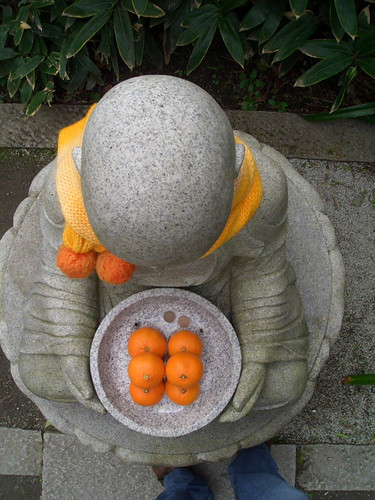
A Long Productive Life

orange offerings 3

Today I was a guest teacher at a university and I met a remarkable elderly man named Hiroshi.  I had the students pair up and talk about jobs they’ve had.  Then each partner would summarize what the other had said.  So Hiroshi’s partner told us that he had been a doctor for 30 years at a public hospital, then he had a private practice for 13 years.  

But Hiroshi corrected her and said, “No, 30 years at the clinic.”

“So 13 years at the hospital, then 30 years at the clinic?”

“No, 30 years at the hospital, and 30 years at my clinic.”

Everyone was incredulous and asked more questions to see if they had heard correctly.  Finally he said, “Hey, I’m 86 years old.  I worked for 60 years.  I only retired 5 years ago.”

So Hiroshi became a doctor at age 21 in the 1940′s and worked into the following century. That’s 6 decades of service as a doctor. And he seemed just as alert and sharp as anyone in that room. I estimate that he’s worked more years than all the people in that classroom combined. That’s amazing. That’s a long productive life.

Pain=Compassion

how to burn a man at the stake

When you’re face down, immobilized with pain, for nearly three days, there’s not much you can do. DVDs and the TV just frayed my nerves. The endless expanse of the Internet was exhausting. It was hard to concentrate while reading books. Eventually, I gave into the pain and boredom and allowed myself to do nothing.

Strange things happen when you are forced to do nothing. For me, old memories, some 20 years old, decided to shake themselves free from the cluttered heap of my brain and sat down with me while they told their stories.

They were like old unsolved mysteries, finally made clear. Continue reading

The King of Pain

headless satori

This past week, I experienced the most excruciating pain I’ve ever felt. The sciatica, which is a pinched nerve, made the agony in my left leg unbearable. Painkillers hardly made a dent in it. Words can’t describe the ordeal, so I’ll paint the picture in cold hard numbers, Harper’s style.

• Days spent immobilized lying flat on my stomach: 3 Continue reading

Arranging Leaves at the Setagaya Art Museum

his and her mosaic thrones

In the previous post, I wrote about a shot I took at the Setagaya Art Museum. Just the path to get to this museum is cool. It’s a pedestrian walkway lined with artificial streams and miniature bridges for kids to play around. There’s also lots of generous seating like the his and hers mosaic thrones above.

The museum itself is in a huge park that used to be a golf course. This suburban museum also has a nice blend of architectural elements, like the serpentine organicism of Gaudi, and the tight geometric texturing of Frank Lloyd Wright.  For more pictures click here.

British Artists

The special exhibit at the museum was an overview of British art called, Twelve Travels, and consisted of 12 British artists, ranging from the venerable JMW Turner to the trendy and always enjoyable David Hockney. Many of the works were done in Japan, so that was a loose unifying theme. There wasn’t much in the way of my favorite sculptor, Henry Moore, but there were many of his sketches which I’d never seen before.

Two other artists made strong impressions on me. The first was Anthony Green who painted whimsical scenes of suburban British life in distorted perspectives on unconventionally shaped canvasses. His paintings were colorful, detailed, and was satisfying like eye comfort food.  I couldn’t find the pieces that I saw at the museum.  But the painting below is quite representative of his style.

AG_0614

The other artist, now probably my favorite artist at the moment, is Andy Goldsworthy who grew up outside of Leeds. He uses natural found objects in the outdoors and arranges them, then takes photographs of the pieces at the moment light hits them perfectly. A movement called land art has arisen from his influence.  They are ‘installations’ in nature.  The pieces are ephemeral since they are made of natural materials and left to the elements.ag-rivergoldsworthy-boulder.3

Wet autumn leaves are arranged by color gradient on rocks in streams. Or are woven together with twigs. Or the twigs are delicately constructed like a web. It’s the perfect art form, with the most beautiful, available and ecological of media, nature.

andy_goldsworthy_rowan_leaves_with_holeandy-goldsworthy-21

Here’s an interview with Andy Goldsworthy.

While searching for Goldsworthy pictures I came across another artist who practices land art. I really like his stuff as well.

And finally, here’s a clip from a BBC documentary about him. 

Meditating Wind no. 66: Forbidden Mandala

Meditating Wind no. 66

The ring of jagged rocks is an art installation at the Setagaya Art Museum. As I was setting up this photo, a man came out of the museum and scolded me for doing this.

“Even though this is outside, this is still art. You can’t just walk in there.” Well, of course I knew this was art. That’s why I was interacting with it in this creative way. But my Japanese was too limited, so I just did what everyone in Japan does, bowed and apologized.

In my defense, there was no sign or tag describing the title and artist.  And no “Do Not Enter” sign.  For all I knew, it was interactive art.  The man also warned me that people have gotten hurt on the jagged edges. If that was the case, I wonder why the piece was displayed in such an open accessible place, where just meters away were many kids running around.

But he was absolutely polite about it. And it was part of the art experience, the symbolism of being told not to enter a circle. A circle that is at once forbidding, because of its sharp edges, and invitingly accessible, because I just had to step over the barrier.