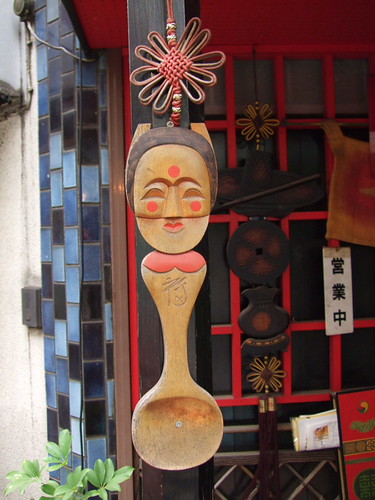
Sumo

in the shadow of giants

After visiting the Edo-Tokyo Museum (which I wrote about in a previous post) we dropped in at the nearby Sumo Museum. The Sumo Museum is one long room inside the Ryogoku Kokugikan, the main sumo hall for the Grand Sumo Tournaments in Tokyo.

There’s minimal English explanation throughout the exhibit but if you’re familiar with some sumo history, you may be able to identify some of the costumes and accoutrements. Otherwise it’s a lot of over-sized clothing and interesting but perplexing objects.

I liked the old bansuke banners, illustrated rankings of the wrestlers during the 19th Century. Even more cool are the portraits, illustrations and photographs of every yokozuna, or grand champion, that line one of the walls. Currently there are two yokozuna, both Mongolian. The haughty, dominating Asashoryu mixes sheer power with perfect technique. And the fearless upstart with the baby face, Hakuho, blends speed and determination.

Currently there are many Mongolians and Eastern Europeans in the ranks. It seems to be a concern among traditionalists. But it couldn’t hurt to expand the global fan base of a sport that is virtually ignored by the younger generation. There’s one high level Korean wrestler, Kasugao. I couldn’t find any information about how he became a rikishi, or wrestler. I usually follow his matches and root him on. Gotta cheer on a brotha.

My favorite rikishi is another Mongolian, Ama, an undersized and slim competitor (for a rikishi anyway), but a skillful wrestler. He’s viewed as an underdog, even though he’s one of the top-ranked, because he’s smaller than almost all his opponents. Even so, he’s 185cm/6’1” and 124kg/273lbs. Although, when I first started following his career two years ago he weighed under 100kg. His demeanor comes across as humble, with his pock-marked face and restrained manners.

Here’s a video clip of one of Ama’s matches. It gives you a good taste of the kind of power, speed and quickness necessary to succeed. These are basically football linemen brutally pounding, slapping, pushing, throwing and flipping each other without football pads or helmets. Ama is the one with the brown belt.

Art Is For The Spirit

jonathan borofsky

Art is for the Spirit is the latest exhibit at the Mori Art Museum. Unfortunately, it ends today. If you were lucky enough to catch the show, you enjoyed one of the best collections of modern art, from the UBS Art Collection, organized in an intelligently coherent way. I liked the three themes of “Body”, “Built World”, and “Space”, roughly corresponding to portraits, the built environment, and nature.

The title piece, by Jonathan Borofsky, exemplifies the aim of the exhibit which is to show the connection between art and life. Borofsky also wanted to convey that art isn’t for money, that the primary reason we do art is to feed the soul. There is irony in all of this of course since the original artwork is worth lots of money, a print will cost you $6,000, it belongs to a collection owned by a very large Swiss bank, and it is displayed in a museum owned by one of the richest men in Japan. You also have to pay 1,500 yen to look at it. Fortunately, T was able to score us tickets through her nefarious connections in the banking world.

The sample of the collection shown at the Mori is star-studded with celebrity artists ranging from the venerable Roy Lichtenstein and the iconic Andy Warhol to the latest hot artists like the provocative Damien Hirst and the imaginative narcissist, Cindy Sherman, who’s entire body of work consists of self-portraits.

The exhibit is pretty European and North American heavy, but being shown in Tokyo, there was an attempt to introduce Japanese and other Asian artists, as well as artists from Latin America. Among these, in Qin Ga’s Miniature Long March, the artist retraces Mao’s Long March and has a map of the journey tattoo’d on his back. That’s commitment to your art!

My favorite pieces were by the Columbian artist, Oscar Munoz. His works addresses the political instability and danger of living in his country. In one work, Project for a Memorial, four screens show his hand drawing portraits, one by one, with a brush using only water on pavement. Even as he sketches the face, it begins to evaporate, showing how transitory a life is, disappearing as soon as it comes into being.

In Pixels, portraits of slain men from police photos, casualties of the drug war, are made from sugar cubes stained with coffee, resembling pixels from a digital sepia photograph. Sugar and coffee: Columbia’s two biggest legal exports. Such an imaginative use of symbolic everyday materials was a masterful way to convey the economic impact of those industries on his subjects. It’s hard to see the faces on this photograph from this angle. Try looking from further away.

pixels by oscar nunez

The Mori Art Museum, located at the top of Roppongi Hills, is one of the more expensive museums in Tokyo. But the cost includes a free audio guide in English, which I found extremely informative, and access to the Tokyo City View observation deck. The 360 degree panorama is completely unobstructed by other tall buildings. Also unlike other museums, which usually close around 5pm, the Mori closes at 10pm, except on Tuesdays.

So you can go there after work, take your time perusing the art, and then stroll along the big windows enjoying the night view. T and I sipped wine at the bar while looking over the city, trying to locate Tokyo landmarks. We were able to identify our apartment building and our work places, tiny smudges of shapes and light. The entirety of our daily lives were laid before us like a distant memory, the casual sketch of our efforts evaporating into the glittering night.

Petals and Other Fleeting Moments

meguro river in bloom 1

Catch it quick because it’s only going to last another week. One strong wind or a heavy rain can end it in an afternoon.

meguro river in bloom at night

Once a year Japan consummates its obsession over cherry blossoms. There have been months of cherry blossom blooming forecasts and updates on the news. People make itineraries to squeeze in as much cherry blossom viewing as possible. College kids and seniors arrive early in the morning at parks to stake out and defend a small picnic area under the blooms. Some of the larger popular parks are crammed with a patchwork of plastic blue tarps filled with revelers drinking beer and eating festival food. The paths are lined with food stalls and if you’re lucky, there may be some dancing and entertainment.

meguro river in bloom at night

It’s a fantastic time. Which is the reason T and I decided to spend our Spring vacation in and around Tokyo this year, instead of traipsing around some tropical locale as usual.

A good tour would balance the famous sites with lesser known places. Ueno Park probably has Tokyo’s best mass display. For the finest night time viewing, walk around the Imperial Palace. It has trees illuminated for a dramatic viewing. Yoyogi Park has the biggest picnic party atmosphere. For more space, you can visit the stately and well-kept Shinjukukyoen. But my favorite spot is the Meguro River in Nakameguro, accessible on the Hibiya and Toyoko lines.

open hedgehogs

Like most rivers in large cities, the Meguro River is nothing more than a concrete-lined stream, but it’s lined with cherry trees with branches that droop down towards the water. The surface of the stream is lightly salted with pink delicate petals. The lanterns illuminate the petals on the trees at night for a romantic cozy ambiance.

Nakameguro is an artsy neighborhood peopled with bohemian designers and artists. The streets along the Meguro River are crammed with inviting cafes, chic restaurants, over-priced salons, and funky boutiques. It has a nice used furniture store full of designer cast-offs and a cool bookstore with lots of odd English books. And whenever I visit I make a point of getting a latte at the Café Madeleine. We happen to run into some friends there.

cafe madeleine

Run out of a the back of a Citroen, the coffees are hand crafted by the humble barista (who has never been to France) in the cramped back seat. I recommend the Madeleine latte, which has an intriguing blend of spices. It takes about 7 minutes to make one. And it comes with a chocolate.

Then continue strolling along the river, contemplating how fleeting and delicate life is.

red bridge and lanterns

Rooftop, My Favorite Soap Opera Character

jerry berry

The Trickster
Of all the archetypes that Carl Jung wrote about, and later Joseph Campbell outlined in his masterpiece of myth, The Hero with a Thousand Faces, I most identified with the trickster. This might be why April Fool’s Day is my favorite holiday. It’s also my dear friend, Jerry McGill’s birthday.

Fittingly, Jerry has all the tools of a contemporary trickster. He is an accomplished writer, film maker, actor, dancer, comedian, singer, and teacher. And he does these exceedingly well. He’s also a snake charmer, a womanizer, and most tragically a Knicks fan. He truly is a renaissance man of the arts, the modern day trickster. Lost in the shuffle of his kaleidoscopic identity is the fact that he’s quadriplegic. After a few minutes with him though, it’s the one part of him that becomes quickly irrelevant.

I first met Jerry in our local YMCA. Like all great friendships it began with neither of us having a favorable impression of each other. With his brash New York demeanor, I thought he was kind of a cocky jock. He thought I was aloof and arrogant. It turned out that he actually is a cocky jock. And as for myself, I really wasn’t the paragon of humility. So we never talked in the gym. Then one evening, after one of my dance performances, I saw that he and his girlfriend had attended. I didn’t realize he was a lover of the arts and an artist himself. As fellow performers, we quickly bonded.

A Fellow Dancer
I later learned that before he was shot in the back during a random drive-by shooting, he himself was a promising dancer. Out of hundreds of inner-city kids, he was one of 3 who successfully auditioned to apprentice with the Eliot Feld Ballet, a big-time contemporary dance company.

Being in a wheelchair didn’t stop him from dancing, however. Eugene, Oregon, where we lived, was and is the center of a dance organization called DanceAbility, a project inviting dancers with and without disabilities to dance together. Jerry called up the director, Alito Alessi, and said, “Hey, I’m Black and I’m in a wheelchair. You got any scholarships for someone like me?” Alito laughed and invited him to the workshops. Like every other organization and project he’s been a part of, he became an integral leading member of DanceAbility.

Shouting from the Rooftop
Jerry’s main art though has been acting and filmmaking. We still tease him about his stint on The Guiding Light, an American television soap opera, in which he played a character named Rooftop. After realizing he could actually act, thus making the other actors look bad, the writers eventually killed off his character. Most recently he was cast as a homeless camp landlord in Conversations with God. While the movie was widely panned, his performance was repeatedly singled out as one of the few bright spots in the movie.

Throughout the years, he’s produced some of his own short films. If I remember correctly, That Summer of Purple is a charming romance about a cynical New Yorker who goes to a small town in the Northwest and gets involved with a single mother and her kid. His latest project, Gwendolyn, is about a transvestite cabaret singer, with Jerry as the sequined lead.

The Teacher
These days, after years of teaching theater workshops for inner-city kids, working at a homeless shelter for teens, and as a counselor for Mobility International, he’s getting his Masters in Education so he can teach in public schools. “I’ve always loved working with young people. It’s kind of in my blood. We seem to get along well.”

Jerry’s connection with kids led us to collaborate on a children’s theater troupe, performing music and slapstick. Once, when performing to hyperactive hippie children, the kids were so excited that they rushed the stage and mobbed us. Good times.

The Scrabble Nemesis
After years of being friends, it had never occurred to me to ask him how he ended up in his wheelchair. We worked out together, went to bars, smoked cigars, caroused around town, sang karaoke, and had one very contentious Scrabble game during which we almost came to blows. Seriously. We laugh about this now, but after a moment of laughing we would both be still a little pissed off about it, and would go back to arguing over the words in contention.

Through it all, the only time Jerry’s wheelchair was an issue was when me and one of our other friends argued over who got to sit with him courtside in the wheelchair section, during basketball games, and in the sweet, spacious wheelchair booth during football games.

jerry and wind

It wasn’t until a book came out that I thought about what Jerry had gone through in his life. One of his childhood friends, Dalton Conley, wrote a memoir titled, Honky, about his experience as a White kid growing up in a Black neighborhood. Jerry, as Dalton’s best friend, figures prominently in the book, as a bright-eyed, sparkling, charismatic personality, exuding promise. Conley traces their friendship until Jerry got shot, after which Jerry was hospitalized, and Conley’s parents ended their experiment in living in the projects.

After reading this book, an excellent sociological autobiography by the way, I understood something about his stubbornness, which must have helped him to get through all the trauma, the surgeries, the radical adjustments in lifestyle. At the same time I recognized the talented trickster, the kid with the sparkly eyes, which must have been even more important to just stay in love with life, to create art out of experience.

When we’re out and about, people he doesn’t know often come up to him and tell him what an inspiration he is. I don’t know if this annoys him, but he’s always gracious with well-meaning strangers. Maybe he is inspirational. But it’s not because he’s in a wheelchair. It’s because he’s fulfilling his promise as an artist, taking the role and the lines that were given to him and stealing the show.

The Edo-Tokyo Museum

the spidey escalator
Entrance to the Edo-Tokyo Museum

The Edo-Tokyo Museum near Ryogoku Station in Tokyo, is a massive concrete hangar-like structure with a broad outdoor plaza designed for hundreds of school kids and senior citizen tour groups. The main exhibit is divided into two zones. One features the history of Edo, what Tokyo was called before the Meiji Era, and the other features how Edo became the Tokyo that we now know. The exhibit consist mostly of scale models of historical street scenes and buildings, dioramas of daily life, and lots of artifacts. Give yourself at least three hours to see the whole thing, four hours if you’re like me, ponderously reading the posted information and looking for interesting details. Among the details I learned was that low-level samurai had very simple lives. Their daily living things were often rough and utilitarian.

In the Edo Zone I found a particularly interesting corner devoted to the Korean diplomats who came when a new Japanese Shogun rose to power. The processional was described as a highlight of cultural exchange for the Japanese. This was a time for local scholars and technicians to visit the Koreans and get the latest in technology, philosophy, religion and statecraft, while the general populace regaled in the horsemanship of the guards. As for any other Korean references I found it odd that no displays were devoted to the Japanese occupation of Korea since there were lots of Tokyo-Seoul connections during this time. In contrast, there were displays on the occupation of Manchuria, as well as war with the Chinese and Russians.

korean processional
Korean processional

My favorite thing about the museum were the huge floor maps of Edo. It was fun to walk over the city and look for my neighborhood, Ebisu, only to find that it was farmland in the outskirts of the city.

edo map
Edo map

A Kawase Hasui exhibit was included in the regular ticket price and consisted of his works of ukioe prints. It was interesting when they put up current photographs of the same scenes he illustrated. Mostly it was poignant to see a beautiful scene worth portraying become a concrete eyesore. For those interested, there were good notes on the printmaking process.

Tensho-in Atusu-hime was thoroughly informative on a little known but critically important member of the Tokugawa clan. She helped to make a peaceful transition (for Edo anyway) to anti-Shogun forces. Otherwise, it was far too crowded to get a good viewing. The displays were text heavy and therefore uninteresting for the non-Japanese literate, and were packed in with readers even if you could read Japanese. Even if you could read it and secured a spot over the display, it was written in an ornate old style of writing that is difficult to read. Still, there were some special pieces, such as silk, brocade robes and exquisite paintings. But the galleries were packed with visitors who drawn to the exhibit because they had watched the TV show of the princess. In short, while the subject matter was fascinating, the exhibit wasn’t worth the 900 yen admission fee.

The main exhibit of Edo and Tokyo, however, was well worth the 600 yen admission, free with the Grutt pass.