Dipping into Salsa
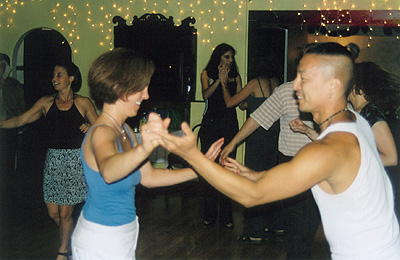
I first started dancing salsa in 1995, when a fellow modern dancer came back from Cuba and showed me some moves. It was easy learning the basic step, and being a good improviser I was able to convincingly approximate the look of salsa. But it was years before I was able to really lead a partner, thanks to a fiery redhead, and do the choreography correctly, thanks to another redhead inviting me to be her partner in a salsa dance company. And after all these years, I’m still a little lax about keeping count, and loose with proper orthodox forms. But that’s me, I’m not much of a stay in the structure kind of guy.
Monthly Archives: October 2007
Water Poetry 2: The Elizabethan Sonnet
Earlier this week I presented the haiku. Today I present the Elizabethan sonnet. The first sonnets appeared in Italy, and is designed for the rhrythmic syncopation of the Italian language, where every other syllable is stressed. Adapted into English, that rhythm is somewhat awkwardly transposed into the iambic pentameter, a line of poetry that consists of 10 syllables, with every even syllable stressed. There are a variety of sonnets, each with its own rhyme scheme. But every sonnet is written in iambic pentameter.
So to write an Elizabethan sonnet you must follow these guidelines: Continue reading
Water Poetry 1: The Haiku
A few years back when I found myself in four countries in three months, I wrote four poems dedicated to a body of water in each of those countries. I also decided to write the poem in four poetic forms native to or popular in those countries. They included an Elizabethan sonnet about the Thames River, a villanelle about the Seine, an open-form or beat poem about the San Francisco Bay, and a haiku about the Tama River. I’ve since added a sijo about the Han River.
I’m going to print those here in a series, with an explanation about the poetic form so you can try it too. And periodically I’ll try to add more poems in different poetic forms around the world. I’m already planning to write a sijo about the Han River.
So today I present the haiku. Continue reading
Kimu Katsu
Living in Ebisu there is an embarassment of riches in restaurants. One of the most popular is Kimu Katsu. On any given night there is a long line of people waiting outside to get a table. On my way home, I’m always asked by people on the street how to get there. My Japanese is quite poor, but when I hear, “Kimu Katsu”, I just smile and walk them to the restaurant. T and I were always intrigued but were unwilling to wait. After all, Tokyo is full of fabulous restaurants with no wait.
So whenever we walk past the restaurant and there is no one waiting, we walk in and dig in. This has happened exactly three times in the last two years. So what are people waiting in line for?
The Floating World in Ueno Park
This past week I taught near Ueno Park, Tokyo’s most important park. There are several museums there, smaller galleries, a zoo, theaters, lakes and ponds, temples and shrines, and even a sizeable homeless camp. It’s one of my favorite places in Tokyo. After work I had meant to check out the visiting exhibition from the Philadelphia Museum of Art, one of the finest collections of impressionists in the world. But by the time I finished a late lunch and then enjoyed the autumn air it was getting late and near closing time, so I opted for another day for a fuller viewing.
Nevertheless, art is everywhere, and on this day I chanced upon a string of lanterns that lined the park’s main thoroughfare. They were a series of woodblock prints, called ukiyo-e (translated as ‘the floating world’), which were a popular form of affordable art during the Edo Period.
Most seemed to commemorate some sort of formal diplomatic exchange between Westerners and Japanese. I suspect it was a treaty signing or trade agreement. In any case, the lanterns will be there until October 31, and are lit from 6-9pm.


